The other main part of my build out focuses in on the legs of my reliquary. Clawed feet on reliquaries are not uncommon, but the specific legs I hoped to recreate are on my Nana’s chair which my Dad gave her in the late 70’s. This chair now belongs to me, and while I might reupholster it, the legs are a touchstone for my childhood.
concept
When I first built the legs in Rhino, they were flat on either side with a small ridge detail in the center. But looking at the Queen Anne style, they’re well known for their wide wings on either side. While this process took far longer than I expected to crack, I’m pleased with the results on the box. Embedded into the wings are small crescents which were the signature design on my grandmother’s chair.
THE EXECUTION
These elements were also 3D printed. In order to ensure a decent print, I split them in half and laid the flat sides down toward the bed. Each leg took around two and a half hours to print. Once printed, I glued the two halves together. Using hot glue, I patched the seam between the two halves and sanded it down.
Once glued, I painted the legs to match the frames of the box. I put a bit extra over the crescents to highlight the details.
Three frames with one leg getting finishing touches with paint.
REFLECTIONS
As I found in the frames, what started as a project for my father has slowly become a reflection on both my Dad and Nana’s lives. They were incredibly close during my life, and there wasn’t a night that passed that my Dad didn’t call and check in. My sister and my relationship with my Nana was so important to my Dad that we had a standing Saturday visit until I was old enough to work. Celebrating them both feels more true in a way when remembering who they were and the lives they led.
In the process to remember my Dad and honor his life, I’ve decided to build out a reliquary from more contemporary materials — 3D printing and plexi/acrylic.
The entire structure will be made of two main parts: the frames which will house the plexi, and the legs. This post will document the process of creating the frames.
Concept
At first I wanted the frame to be an homage to my Dad’s childhood home, with magnolias budding from vines that were engraved into the frame. But trial and error proved that the flowers would have been too small for my scale.
Still, the idea of floral elements and engraving stuck. At first I thought vines would be best, but they proved hard to read on the print (Figure 1). When I was playing around with some more traditional designs, I thought instead to change the scale of the floral pattern. This lead to an oversized, floral pattern that looks like lace around the edges of the frame (Figure 2)
Additionally (and some what unintentionally) it also mimics a system of veins, as the lines continue across the corners of the box. This surprise is poetic; my father passed of a major heart attack.
Figure 1: The vines which previously ‘grew’ up the sides were too fine to print clearly.
Figure 2: Three frames painted before assembly. Gold paint was used to highlight the finer points, giving it motion and definition.
The Execution
While the frames themselves are relatively standard — four sides with pointed edges — I wanted to add a bit of character. The internal edge was rounded to create a softer feel and pair with the lighter accents of the floral design. The frames themselves meet at a 90 degree angle to help the effect of the design.
The 3D printer struggled on some finer details, but in all was able to support the design fully. Recommendations for future iterations might look at varying the design more, or stretching the boundaries of what makes a frame. Because the frame itself was so thick, each side took about 5 hours to print. Future versions that could push those boundaries would see a better return on time.
When painting, I want to keep the box as close to wood-looking as possible. I knew that I wanted to add gold touches, but making the wood texture was important to keep the weightiness of my Dad and his personal style. I used slightly metallic brown paint and a clear filament to achieve this effect. The texture of the print also added to this. I thought the texture would take time to sand down, but it turned out perfectly to mimic grain. (Figure 3)
The frames up close after painting and before assembly. It was important to get a wood-like finish on the box because the materials don’t resemble the tone of my Dad.
Reflections
What I began as a straightforward memorial to my Dad has enmeshed with the death of my Nana, who passed in February 2018. I don’t know that my Dad would have liked the abstract florals, but the idea of lace might have convinced him that my Nana’s hand was in the design. For year, she kept doilies at the end of her sofas, and every table top had a lace runner. The legs — coming soon! — are a mix of both, too.
Rather than dive deeper into the rabbit hole with exploring the world of death, I would like to pivot to a more metaphysical question: What does it mean to remember?
Below is a quick synopsis of the patterns of memory and examples of art projects that have tried to capture memory.
Internal processing: How does memory work?
Memory is both the physiological and neurological pathways which are mapped in our brain. The hinge of memory is extreme timing and synchronicity of neurons to decode stored segments of memory, like a puzzle.
Learning differs from memory in that neurons fire together and are trained to fire together. Memory depends on learning rather than learning on memory because, in order to recall information, we must first make the association neurologically. The only time this relationship is inverted is when we begin to conjecture or infer patterns.
Collective associations: What surrounds memory?
Collective memory is a sociological relationship of knowledge that exists externally. Particularly as I’ve witnessed this process, it’s through the relationships of words and images, or the simulacrum as Jean Baudrillard discusses in his post-modern critique of reality. He argues that the relationships which exist between pieces of information are hyper-real. The most easy to understand example of this interplay and consciousness is memes, which begin as jokes between texts and images, and yet gain personalities.
“Collective memory is also sustained through a continuous production of representational forms,” according to James E. Young, professor at the University of Massachusetts Amherst. Coupled with the process of digitization, Young argues that second-hand memory is more common now than ever. Collective memory is referential memory, and draws on a spiraling staircase of information which builds each time it is reproduced. Young suggests that this dialogue which has both intentional and unintentionally gives social capital and helps create hierarchy between different people.
Grids: An Archive of Collective Memory by artist Siemon Allen follows the trajectory of national identity and sentiment around national identity by close and rigid juxtaposition of trading cards which depict nationalist propaganda. (Cards, 2005 – 2013)Memory Cloud (RE:site and METALAB) will be housed at Texas A&M University in the Memorial Student Center. The piece aims to capture both the permanence and impermanence of human movement. The structure is built from 256 acrylic tubes which contain over 4,000 individual points of light in 12 rows. Each layer can be programmed with a unique video which loops in the feed.
In the pursuit to memorialize a father that exists in my head, I thought it would also be important to begin to understanding what exists in the field of fabrication around death. While the tension for me lies in interaction, the examples I’ve found in the intersection of fabrication and death highlight this tension passively. Granted, because of their potential in the biomedical field, the possibilities are promising. But as to remembering and the act of remembrance, the fabrication world seems to fall slightly short.
3D Printing death masks
Neri Oxman and her team at MIT’s Mediated Matter group have created a strange and cosmic death mask that echoes elements of the practice while pushing the boundaries of what resembles human or natural. This multi-disciplinary task, “Vespers,” incorporated fluid dynamics and fabrication mastery.
“They’ll re-engineer life by literally guiding living microorganisms through minute spatial features inside the artifacts,” Oxman says about her hopes for future iterations of the masks to impact biology.
The resin which flows through the translucent filament creates an organic feeling and contrasts the fluid nature of the piece, which comes across as more inhuman than organic. The interior of the structure is built around the dead’s last breath.
“Each mask represents an imaginary martyr going through a metamorphosis from life to death or death to life,” Oxman says.
Reginative Reliquary
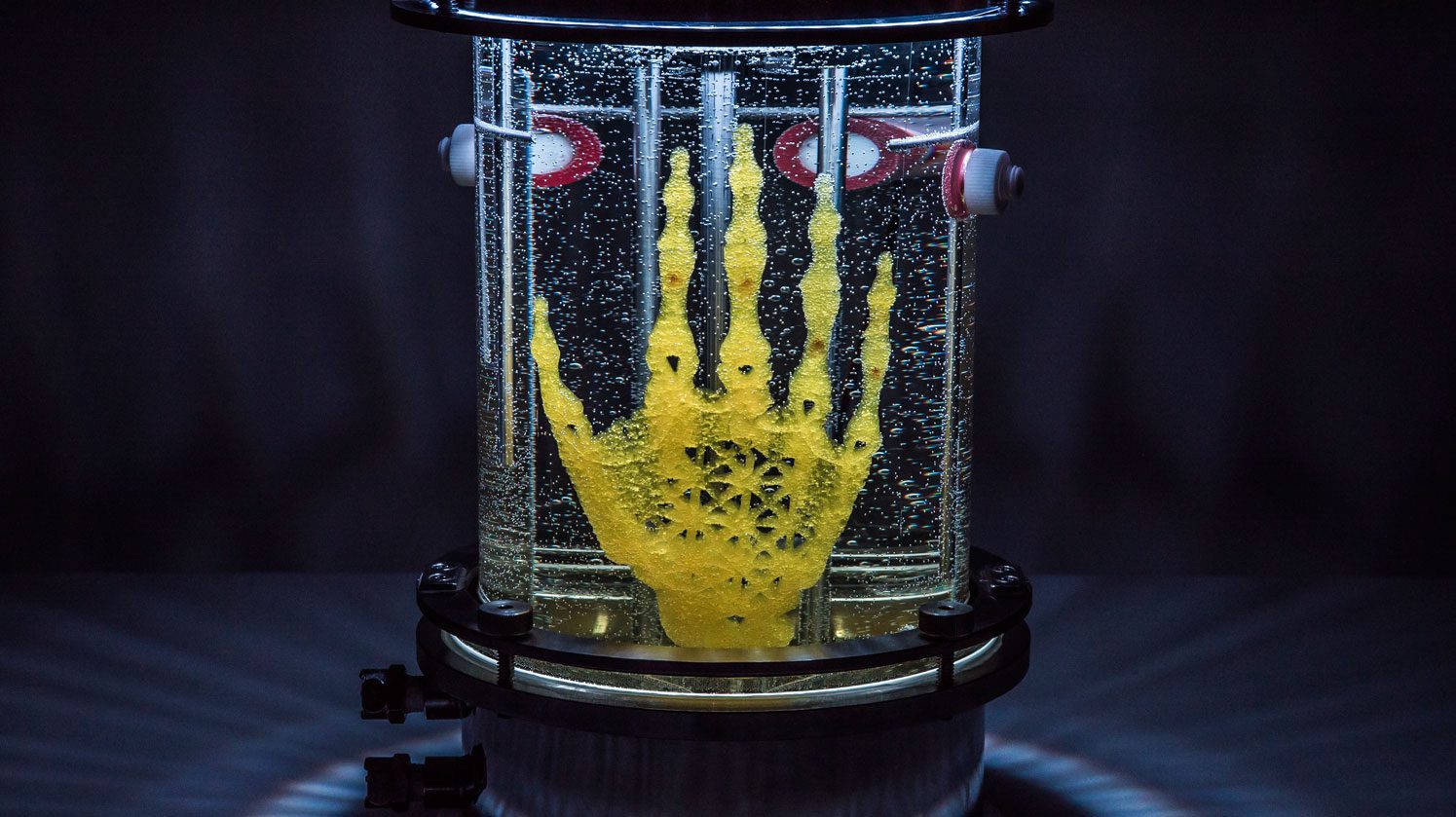
Artist Amy Karle’s “Regenerative Reliquary,” is a bioprinted sculpture in the shape of a human hand. The hand is 3D printed in a biodegradable pegda hydrogel, which dissolves over time. The sculpture is inherently interactive, as the bioreactor which it’s housed in will eventually become the environment which encourages tissue cell growth around the structure.
“I began envisioning a future factory where the same materials – just a few cells, could be used to grow organs, marrow, limbs, and also create art and design objects, even technology for both inside and outside of our bodies… a sustainable factory with low waste, where minute amounts of material can be grown into many different forms, reconfigured and reused for many purposes to enhance and enrich our lives.” — Artist Amy Karle on her inspiration for her 2016 sculpture
Karle writes in her artist statement that she was inspired by the generative and parametric design in the body.
“This piece considers how cells articulate into different forms – what makes a cell become a beating heart, skin, or bone – in naturally occurring ‘additive manufacturing’ created by a multiplier effect. ‘Regenerative Reliquary’ further focuses on the dynamic organ and tissue in our bodies that is constantly remodeling and changing shape to adapt to the daily forces placed upon it: bone.”
“It’s your funeral”
Koffin Company is riding the wave of biodegradable vessels in 3D printing coffins that resemble pods more so than their wooden box predecessors. Their website points to the rise in funeral cost as their primary objective, but adds that the carbon footprint which death exacerbates is another imperative to change the process of burial.
The Koffins are made from a form of Lignin, a bio-material, and are 100 percent biodegradable. They require less energy to burn than wood, and when burned, produce less CO2 than plants when growing.
A variety of Koffins on display in Liverpool. (Credit: Twitter; 2018)
To boot, the company aims to serve those lives they bury, and each Koffin can be made to the occupant and loved ones wishes. Some models even feature windows which are laser cut into the top, reminiscent of submarine port holes.
The base model starts at about $575 and needs to be shipped from the UK — only when necessary, assures the site.
Again, despite the heart which aims at interaction, the pieces summarized here aim less at the action of death and more around death as an emblem. Death is defanged and made a source of life again. Part of me questions what we lose when we humble death this way — what do we give up by redefining and fabricating a narrative which doesn’t end?
Your fluted bones and acanthine hair are littered
In their old anarchy to the horizon-line.
It would take more than a lightning-stroke
To create such a ruin.
Nights, I squat in the cornucopia
Of your left ear, out of the wind,
— Sylvia Plath, “Colossus”
I wanted to dive into the thoughts behind remembrance because — ultimately — I’m trying to think through the ways I might remember my father. But more than that — to see my father as I remember him before illness and age.
Currently, the methods that exist for honoring the dead are stationary and offer little in the way of imagining the person as they were. Below I’ve listed a few of the historic pieces which shape our conventions of death and remembrance, and their advantages in order to understand how to best improve on them.
The Reliquary
These structures are meant to hold images or tokens of the divine. They can be shrines, but differ in that their contents are generally more specific to the person or figure honored.
The earliest reliquaries were boxes, either simple box-shaped or based on an architectural work (i.e. the church). The 9th century saw a rise in cross-shaped designs decorated with precious stones. During the Middle Ages, transparent reliquaries (philatory) rose to prominence despite the cost to produce them. These transparent boxes were designed to exhibit bones and relics.
During the Gothic period, interest increased in seeing the anatomy housed within the relics. This led to the beginning of transparent reliquaries, allowing believers to see them without having the relics removed from the containers. (ca. 1350)
Urn
Pottery urns, or footed vases with covers, date back as far as 7000 BC. Funerary urns are commonly used for cremated remains. Various historical examples show that, while the practice of urns and cremation is not unique, the interaction with them has been. Some cultures chose to bury urns, as shown in the Urnfeild of the Bronze age, while others have put them for display and ritual rites.
Poetree, by the French industrial designer Margaux Ruyant, is a part of the growing trend of environmentally-conscious burials.
The practice of scattering ashes is fairly new, and recently, biodegradable urns have become more commonplace as the answer to a growing carbon footprint. These biodegradable urns can be anything from wooden boxes to being buried with a tree, or taking a dive into the Neptune Memorial Reef.
Mummies + Displaying the Dead
A departure from preserving fragments is the ancient idea of preserving the dead whole. Egyptian mummification practices make their mummies the most notorious. The Egyptians removed all moisture from the body, leaving only a dried form that prevented decay. This practice heavily influenced the modern practices of embalming bodies.
While interaction seems more passive since mummies (and embalmed bodies) are typically buried, it is their permanence mixed with human curiosity which makes them important to note as a source of remembrance. Unlike the urn or the reliquary, the mummy captures the human form to its most full. Similarly, the display of the dead has gone on to shape artwork and notions around death. The most famous interplay is Edvard Munch’s “The Scream,” and a Peruvian mummy which was on display during Munch’s tenure.
Caskets and coffins
Similarly, Egyptian sarcophagi echo another modern tradition: the coffin or casket. Coffin is derived from the French word cofin, which means a cradle or basket. Wooden coffins were commonplace all over the world, and their four-sided box shape seems to have followed. There is no particular date or origin, nor a consensus on why the boxes emerged, simply this idea that the coffin captures a human notion about death and burial.
The casket, rather, is a more Western tradition, but stems from ancient and wide use of ‘caskets’ as jewelry boxes. The modern casket differs from coffins and has a more complex hexagonal shape. Caskets can have ornaments, such as handles, but vary widely based on religious practice and tradition. Most are built from wood, but glass caskets, which are similar to the reliquary, exist to encase the body of someone noteworthy, whether famous or infamous.
The body of Kim Jong Il lies in Kumsusan Memorial Palace. (Source: CNN)




 Process Journal